


Closed-circuit Automated Respiratory Calorimetry System
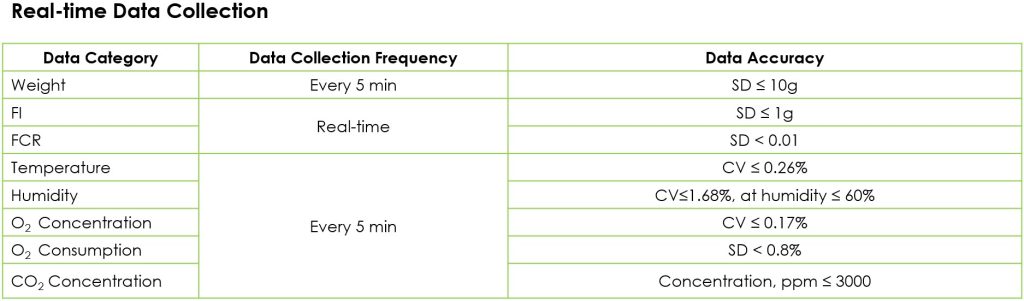
Closed-circuit Automated Respiratory Calorimetry System (CRS) is built on the fundamental principle of indirect calorimetry, adopts a fully enclosed internal circulation configuration, integrates intelligent life support module, intelligent environmental simulation module and intelligent data acquisition & analysis module. CRS system realizes automatic control of the entire testing workflow, minimizes interferences from ambient conditions, animal physiological status and manual operation on measurement results, and improves the testing accuracy.
The CRS System accurately measures oxygen consumption and carbon dioxide production of target animals within a controlled sealed chamber. It further generates data on total heat production and energy partitioning, serving as a key technical platform for net energy evaluation of feeds, energy metabolism research and efficacy assessment of animal nutritional additives. Being the key technique platform for animal nutrition and feed science research institutes, university laboratories, large feed manufacturers and animal production enterprises for formulating reliable and precise feeding solutions for livestock production.
Close-circuit and Automated Internal Circulation Mode
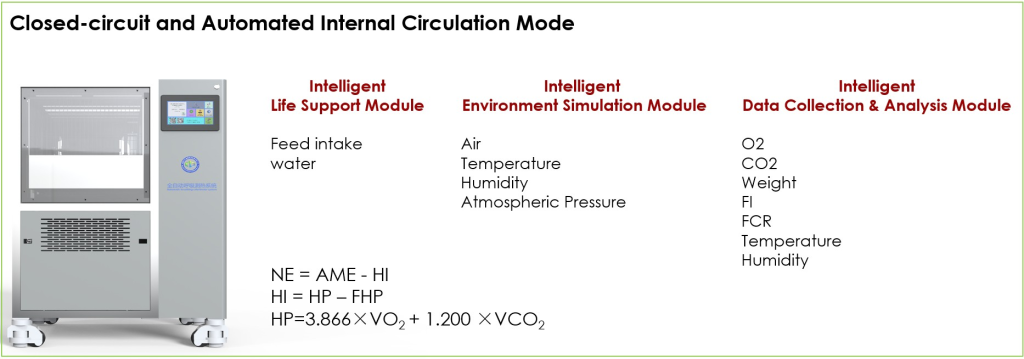
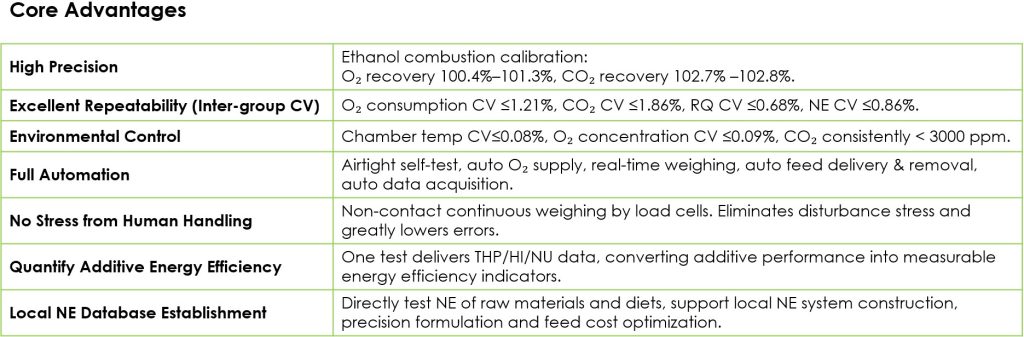
Configuration and Function of CRS
We deliver far more than a single instrument — but a highly automated animal respiratory calorimetry platform. The CRS platform comprises multiple Closed-circuit Automatic Respiratory Calorimeter units.
CRS system enables real‑time visualization of animal growth data, supporting users to build structured databases for net energy, energy metabolism & retention, and animal energy requirements. By continuously collecting and visualizing full‑chain data of animal growth and energy metabolism, CRS synchronously records feed intake, water intake, body weight change, oxygen consumption and carbon dioxide production.
CRS automatically calculates total heat production (THP), heat increment (HI), maintenance heat production and retained energy. Combined with supporting nitrogen balance measurements, retained energy can be further partitioned into protein deposition and fat deposition, so make the flow of energy to be visualized in real time.
| No. | Category | Description | Configuration |
| 1 | Hardware | Closed-circuit Automated Respiratory Calorimeter (CRS) | Standard |
| 2.1 | Software | Master Control System (MCS) | Standard |
| 2.2 | Software | Distributed Control System (DCS): Terminal Data Acquisition | Standard |
| 3.1 | Functional Modules | Chamber Temperature Setting and Monitoring (Constant or Cyclic Temperature Modes) | Standard |
| 3.2 | Functional Modules | Chamber Oxygen Concentration Setting and Monitoring | Standard |
| 3.3 | Functional Modules | Animal Growth Curve | Standard |
| 3.4 | Functional Modules | Oxygen Consumption | Standard |
| 3.5 | Functional Modules | Carbon Dioxide Production | Standard |
| 3.6 | Functional Modules | Basal Metabolic Heat Production (Fasting heat production, FHP) | Standard |
| 3.7 | Functional Modules | Feed Metabolizable Energy(ME), Heat Increment(HI), Net Energy(NE), and Net Energy of Retention (NEr) | Standard |
| 3.8 | Functional Modules | Dynamic Requirement Model of Net Energy Under Multimodal Conditions | Standard |
| 3.9 | Functional Modules | Quantification of Glucose, Protein, and Fat Oxidation | Standard |
| 3.10 | Functional Modules | Real-Time Feed Intake | Optional |
| 3.11 | Functional Modules | Real-Time FCR | Optional |
| 3.12 | Functional Modules | Real-Time Water Intake | Optional |
| 4.1 | Documentation | CRS System Operating Manual | Standard |
| 4.2 | Documentation | CRS System Maintenance Manual | Standard |
How Does CRS Contribute to Your Future Success?
From Laboratory Precision to Precise Feeding
1) Establish Poultry Net Energy (NE) System & Evaluate Feed Ingredient Energy
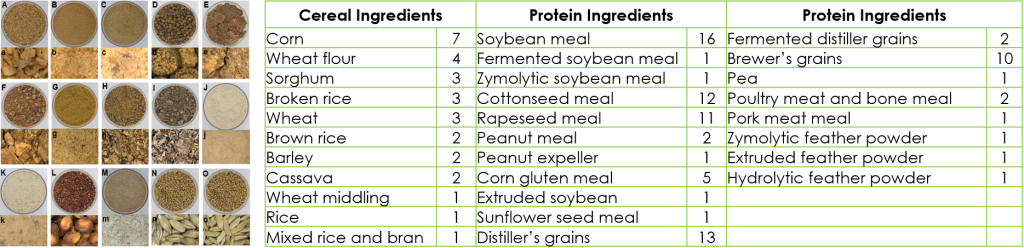
NE is the most accurate available energy indicator for feeds. CRS directly tests THP, HI and NE of diets and raw materials, supporting local NE database construction and precision diet formulation, helping manufacturers shift formulation from ME to NE basis.
2) Determine True Energy Requirements of Animals
CRS quantifies maintenance heat production, retained energy and nutrient intake relationships, to develop energy requirement standards for different breeds and growth phases.
3) Assess Energy Efficiency of Feed Additives & Functional Ingredients
Compare O₂ consumption, CO₂ output, THP, NE and protein/fat deposition between control and treatment groups for enzymes, acidifiers, oils, emulsifiers (lysophospholipids), probiotics and novel raw materials. Obtain precise heat loss and nutrient deposition data to verify additive performance.
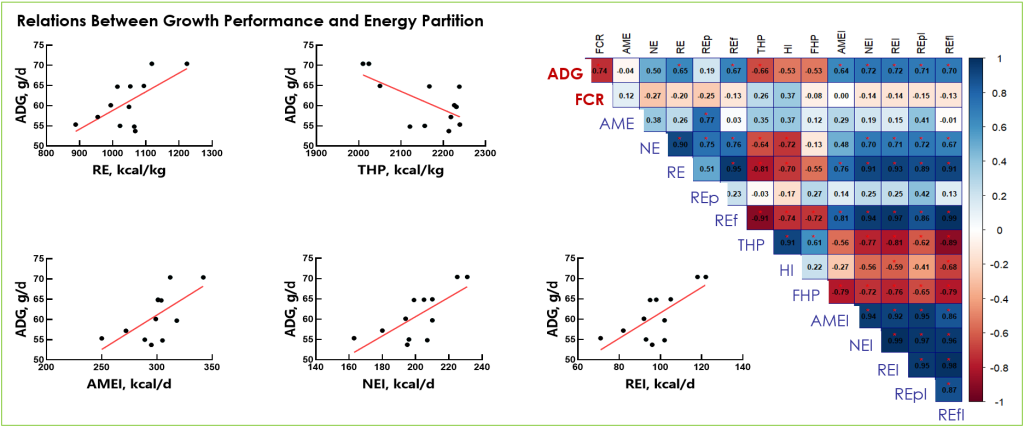
4) Study Temperature & Stress Impacts on Energy Metabolism
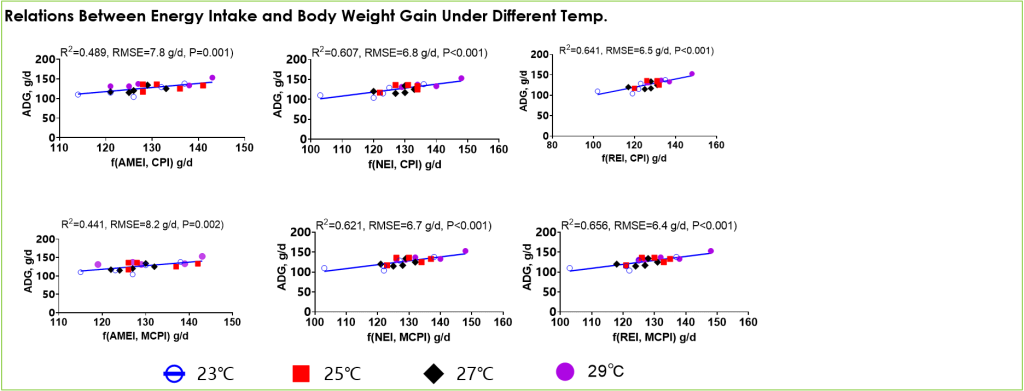
Up to 24 temperature setpoints simulate diurnal barn temperature variation in controlled chambers. Evaluate maintenance energy changes under heat/cold stress and nutritional mitigation solutions, guiding summer feed formulation and welfare farming.
5) Protein & Fat Deposition Partitioning
Coupled with nitrogen balance tests, retained energy can be separated into protein and fat deposition. Applied for breeding, meat quality control, nutrition and feeding regime optimization for precision feeding.
6) Greenhouse Gas Emission Testing
The closed gas pathway can be extended with CH₄ and other GHG analysis modules for livestock emission reduction research and additive mitigation efficacy evaluation. Note: Custom large-size chambers for pigs and ruminants are available on the basis of standard units.